
AI Developer Mastery
Shared from Learning47 links
01 - Roadmaps - Start Here7
- datacamp.com
AI Developer Roadmap: 12-Month Path - DataCamp
 jobcannon.io
AI Career Roadmap 2026 - JobCannon Guide
A step-by-step AI career roadmap for 2026 covering essential skills, salary benchmarks, learning resources, and career paths from entry-level to senior AI roles. Includes ML, prompt engineering, and AI product management tracks.
 zorost.com
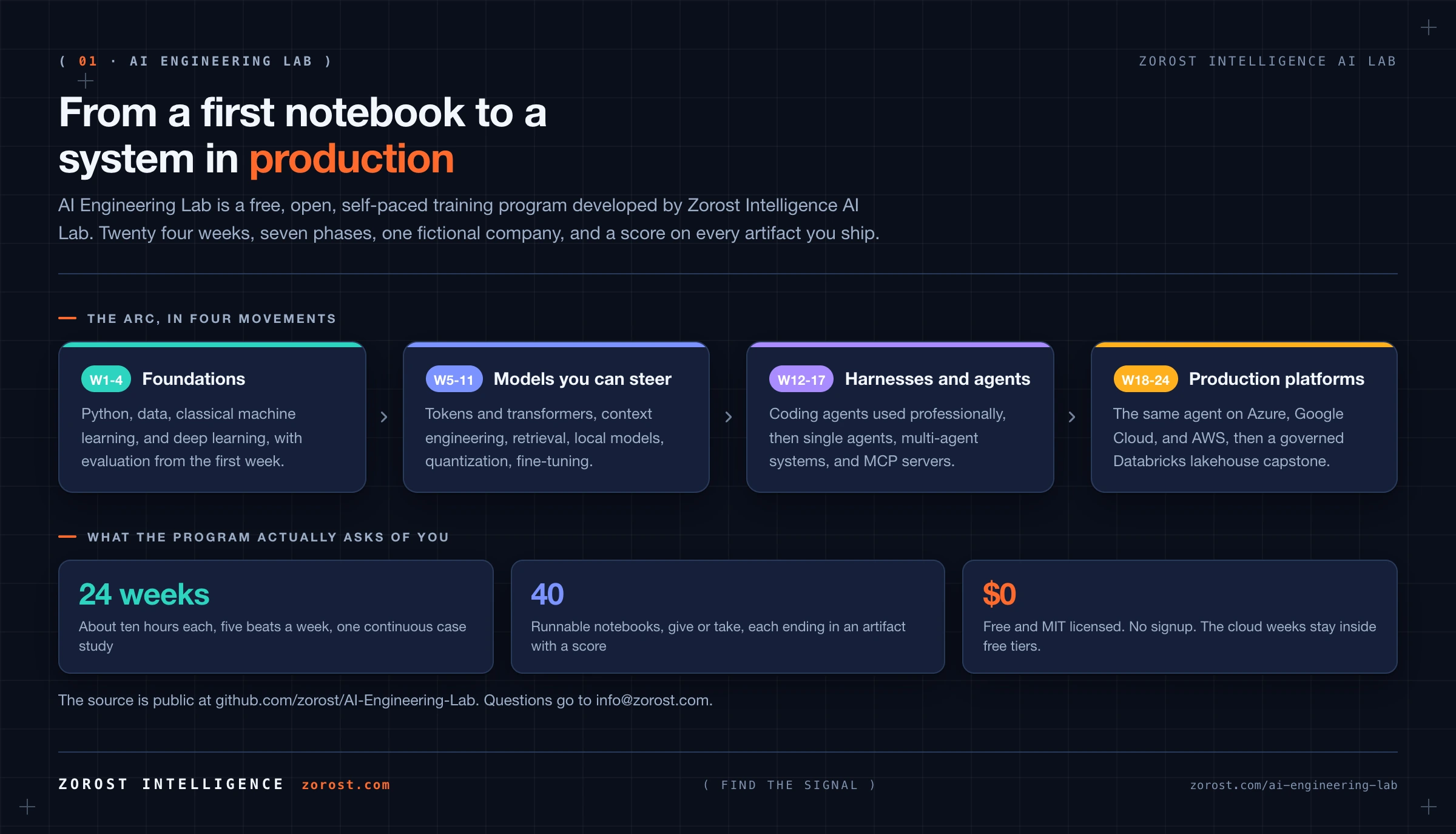
AI Engineering Lab - 24 Weeks to Production (Zorost)
A free, open training program developed by Zorost Intelligence AI Lab. One fictional freight company, 43 runnable notebooks, and a path from Python to agents, three clouds, and Databricks.
- github.com
AI Engineering from Scratch - GitHub Curriculum (rohitg00)
Learn it. Build it. Ship it for others. Contribute to rohitg00/ai-engineering-from-scratch development by creating an account on GitHub.
- webcoderspeed.com
AI and ML Complete Roadmap 2026: Zero to Production
The definitive AI/ML learning roadmap for 2026: what to study, in what order, with realistic timelines and the best free resources. Covers Python, classical ML, deep learning, LLM engineering, RAG systems, and MLOps — for developers who want to ship real AI products.
 coursera.org
AI Learning Roadmap: Beginner to Expert - Coursera
Learn AI in 2026 with a complete roadmap covering foundational concepts, machine learning, deep learning, NLP, and real-world projects. Build practical, job-ready AI skills to thrive in today’s fast-growing, AI-driven economy.
 dataquest.io
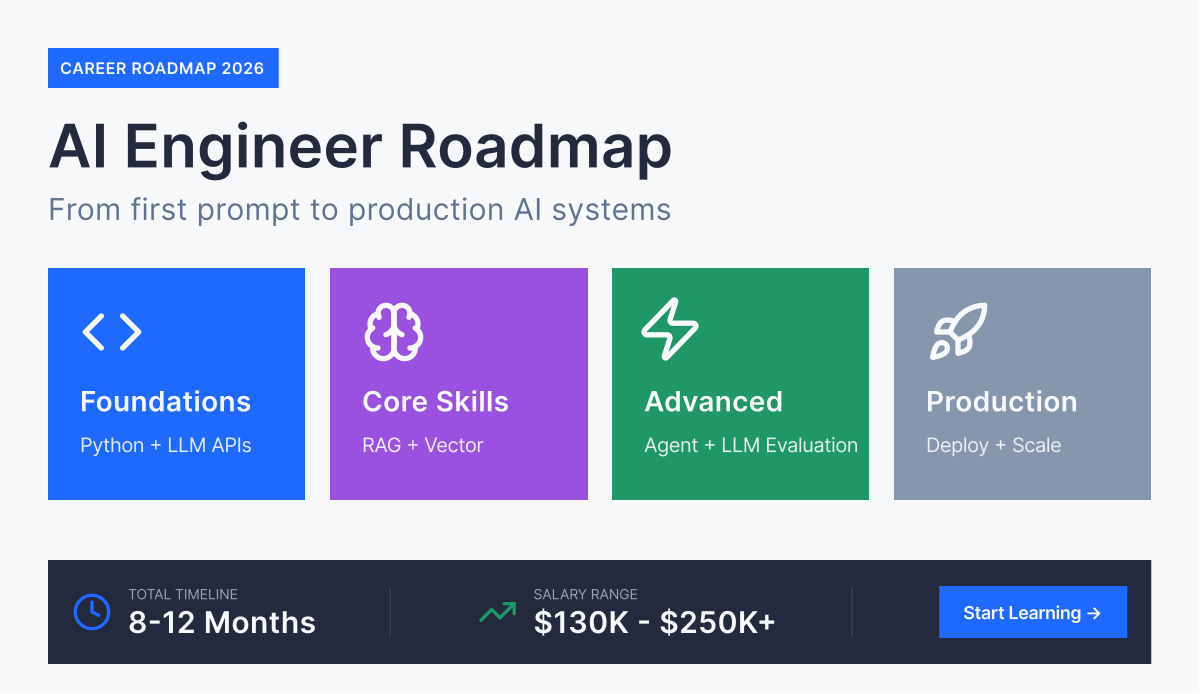
How to Become an AI Engineer in 2026 - Dataquest Roadmap
Thinking about becoming an AI engineer? This roadmap breaks down what to study, the order to follow, and how long it takes to get there.
ai-developerroadmapstart-herecareer
02 - Python - ML - Deep Learning4
 course.fast.ai
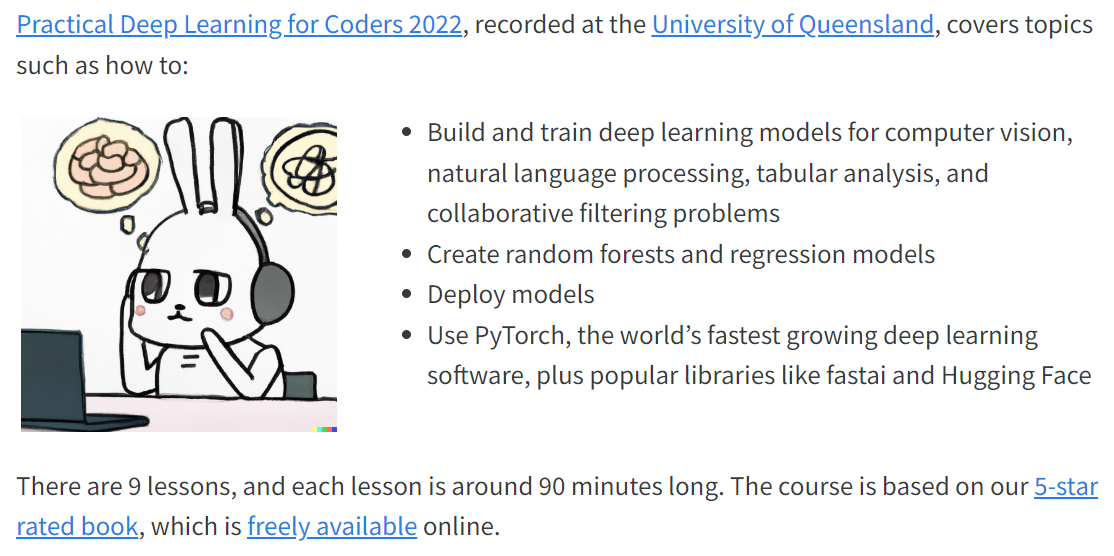
Practical Deep Learning for Coders - fast.ai
A free course designed for people with some coding experience, who want to learn how to apply deep learning and machine learning to practical problems.
 developers.google.com
Machine Learning Crash Course - Google Developers
 coursera.org
Supervised ML: Regression and Classification - Andrew Ng (Coursera)
In the first course of the Machine Learning Specialization, you will: • Build machine learning models in Python using popular machine ... Enroll for free.
 freecodecamp.org
Machine Learning with Python - freeCodeCamp (30h)
Learn to Code for Free
03 - LLM Engineering - Prompting3
 learnprompting.org
Learn Prompting - Complete Prompt Engineering Guide
Learn Prompting offers a comprehensive, free guide on Generative AI and Prompt Engineering, perfect for beginners and advanced users alike. Start your AI journey now!
- wiszniewsky.pl
Free AI Engineer Course Zero to Pro - Wiszniewsky
Free AI Engineer course — LLM APIs, RAG, GraphRAG, AI agents, LLMOps, enterprise clouds. 119 video lessons, 5 portfolio projects, certificate. Start free →
- hysenlabs.com
AI Engineering in Practice - Hysen Labs (Free Course)
A free AI course for developers. First build things that work with large language models, then implement neural networks and a Transformer from scratch to see why they work.
04 - RAG - Agents - MCP4
- github.com
AI Agents for Beginners - Microsoft (15 Lessons, GitHub)
18 Lessons to Get Started Building AI Agents. Contribute to microsoft/ai-agents-for-beginners development by creating an account on GitHub.
 deeplearning.ai
MCP: Build Rich-Context AI Apps with Anthropic
Build AI apps that access tools, data, and prompts using the Model Context Protocol.
- docs.langchain.com
LangChain Agents Overview - create_agent Quickstart
LangChain provides create_agent: a minimal, highly configurable agent harness. Compose exactly the agent your use case needs from model, tools, prompt, and middleware.
- docs.langchain.com
Build a Semantic Search Engine + RAG - LangChain Docs
05 - Courses - Certifications4
 godofprompt.ai
100 Free AI Courses - God of Prompt (Curated List)
Genuinely free AI courses from Stanford, MIT, Anthropic, Google and more. Filter by topic and level, from AI literacy to building LLMs and agents.
- deeplearning.ai
DeepLearning.AI Short Courses (Free Videos)
Learn AI with DeepLearning.AI
- github.com
Generative AI for Beginners - Microsoft (21 Lessons, GitHub)
21 Lessons, Get Started Building with Generative AI - microsoft/generative-ai-for-beginners
 huggingface.co
Hugging Face LLM Course (Free, 12 Chapters)
We’re on a journey to advance and democratize artificial intelligence through open source and open science.
06 - YouTube - Videos9
- youtube.com
DeepLearningAI - YouTube Channel
 learnwithpath.com
10 Best AI YouTube Channels 2026 - Ranked Guide
Compare the 10 AI YouTube channels worth your time in 2026 - subscriber size, level, and what each teaches - so you can pick one and start building today.
- youtube.com
Building LLMs from Ground Up - Sebastian Raschka Workshop
- youtube.com
IBM Technology - AI Explainers (YouTube)
- youtube.com
LangChain - Framework-Native RAG and Agents (YouTube)
- youtube.com
Cole Medin - Shipping Real AI Agents (YouTube)
- youtube.com
3Blue1Brown - Visual Math for Transformers (YouTube)
- youtube.com
Andrej Karpathy - YouTube Channel
- youtube.com
Lets Build GPT From Scratch - Andrej Karpathy (YouTube)
07 - Research Papers8
- github.com
Machine Learning Library - 590 Doc Curated Corpus (GitHub)
A hand-curated library of the best machine learning education — 590 docs (78 arXiv papers, 474 course lectures from Stanford/MIT/Karpathy/fast.ai, 38 explainer articles), normalized to Markdown wit...
 arxiv.org
Generative Adversarial Networks - Goodfellow et al. (arXiv)
We propose a new framework for estimating generative models via an adversarial process, in which we simultaneously train two models: a generative model G that captures the data distribution, and a discriminative model D that estimates the probability that a sample came from the training data rather than G. The training procedure for G is to maximize the probability of D making a mistake. This framework corresponds to a minimax two-player game. In the space of arbitrary functions G and D, a unique solution exists, with G recovering the training data distribution and D equal to 1/2 everywhere. In the case where G and D are defined by multilayer perceptrons, the entire system can be trained with backpropagation. There is no need for any Markov chains or unrolled approximate inference networks during either training or generation of samples. Experiments demonstrate the potential of the framework through qualitative and quantitative evaluation of the generated samples.
- arxiv.org
Chain-of-Thought Prompting Elicits Reasoning (arXiv)
We explore how generating a chain of thought -- a series of intermediate reasoning steps -- significantly improves the ability of large language models to perform complex reasoning. In particular, we show how such reasoning abilities emerge naturally in sufficiently large language models via a simple method called chain of thought prompting, where a few chain of thought demonstrations are provided as exemplars in prompting. Experiments on three large language models show that chain of thought prompting improves performance on a range of arithmetic, commonsense, and symbolic reasoning tasks. The empirical gains can be striking. For instance, prompting a 540B-parameter language model with just eight chain of thought exemplars achieves state of the art accuracy on the GSM8K benchmark of math word problems, surpassing even finetuned GPT-3 with a verifier.
- arxiv.org
GPT-3: Language Models are Few-Shot Learners (arXiv)
Recent work has demonstrated substantial gains on many NLP tasks and benchmarks by pre-training on a large corpus of text followed by fine-tuning on a specific task. While typically task-agnostic in architecture, this method still requires task-specific fine-tuning datasets of thousands or tens of thousands of examples. By contrast, humans can generally perform a new language task from only a few examples or from simple instructions - something which current NLP systems still largely struggle to do. Here we show that scaling up language models greatly improves task-agnostic, few-shot performance, sometimes even reaching competitiveness with prior state-of-the-art fine-tuning approaches. Specifically, we train GPT-3, an autoregressive language model with 175 billion parameters, 10x more than any previous non-sparse language model, and test its performance in the few-shot setting. For all tasks, GPT-3 is applied without any gradient updates or fine-tuning, with tasks and few-shot demonst
- arxiv.org
ReAct: Reasoning + Acting in Language Models (arXiv)
While large language models (LLMs) have demonstrated impressive capabilities across tasks in language understanding and interactive decision making, their abilities for reasoning (e.g. chain-of-thought prompting) and acting (e.g. action plan generation) have primarily been studied as separate topics. In this paper, we explore the use of LLMs to generate both reasoning traces and task-specific actions in an interleaved manner, allowing for greater synergy between the two: reasoning traces help the model induce, track, and update action plans as well as handle exceptions, while actions allow it to interface with external sources, such as knowledge bases or environments, to gather additional information. We apply our approach, named ReAct, to a diverse set of language and decision making tasks and demonstrate its effectiveness over state-of-the-art baselines, as well as improved human interpretability and trustworthiness over methods without reasoning or acting components. Concretely, on
- arxiv.org
Retrieval-Augmented Generation - Lewis et al. (arXiv)
Large pre-trained language models have been shown to store factual knowledge in their parameters, and achieve state-of-the-art results when fine-tuned on downstream NLP tasks. However, their ability to access and precisely manipulate knowledge is still limited, and hence on knowledge-intensive tasks, their performance lags behind task-specific architectures. Additionally, providing provenance for their decisions and updating their world knowledge remain open research problems. Pre-trained models with a differentiable access mechanism to explicit non-parametric memory can overcome this issue, but have so far been only investigated for extractive downstream tasks. We explore a general-purpose fine-tuning recipe for retrieval-augmented generation (RAG) -- models which combine pre-trained parametric and non-parametric memory for language generation. We introduce RAG models where the parametric memory is a pre-trained seq2seq model and the non-parametric memory is a dense vector index of Wi
- arxiv.org
BERT - Pre-training Deep Bidirectional Transformers (arXiv)
We introduce a new language representation model called BERT, which stands for Bidirectional Encoder Representations from Transformers. Unlike recent language representation models, BERT is designed to pre-train deep bidirectional representations from unlabeled text by jointly conditioning on both left and right context in all layers. As a result, the pre-trained BERT model can be fine-tuned with just one additional output layer to create state-of-the-art models for a wide range of tasks, such as question answering and language inference, without substantial task-specific architecture modifications. BERT is conceptually simple and empirically powerful. It obtains new state-of-the-art results on eleven natural language processing tasks, including pushing the GLUE score to 80.5% (7.7% point absolute improvement), MultiNLI accuracy to 86.7% (4.6% absolute improvement), SQuAD v1.1 question answering Test F1 to 93.2 (1.5 point absolute improvement) and SQuAD v2.0 Test F1 to 83.1 (5.1 point
- arxiv.org
Attention Is All You Need - Vaswani et al. (arXiv)
The dominant sequence transduction models are based on complex recurrent or convolutional neural networks in an encoder-decoder configuration. The best performing models also connect the encoder and decoder through an attention mechanism. We propose a new simple network architecture, the Transformer, based solely on attention mechanisms, dispensing with recurrence and convolutions entirely. Experiments on two machine translation tasks show these models to be superior in quality while being more parallelizable and requiring significantly less time to train. Our model achieves 28.4 BLEU on the WMT 2014 English-to-German translation task, improving over the existing best results, including ensembles by over 2 BLEU. On the WMT 2014 English-to-French translation task, our model establishes a new single-model state-of-the-art BLEU score of 41.8 after training for 3.5 days on eight GPUs, a small fraction of the training costs of the best models from the literature. We show that the Transforme
08 - Tools - Frameworks7
 calmops.com
Python AI Libraries 2026 Complete Guide - Calmops
Discover the best Python AI libraries in 2026. Complete guide covering LangChain, LlamaIndex, Hugging Face, PyTorch, and emerging libraries for AI development.
 trychroma.com
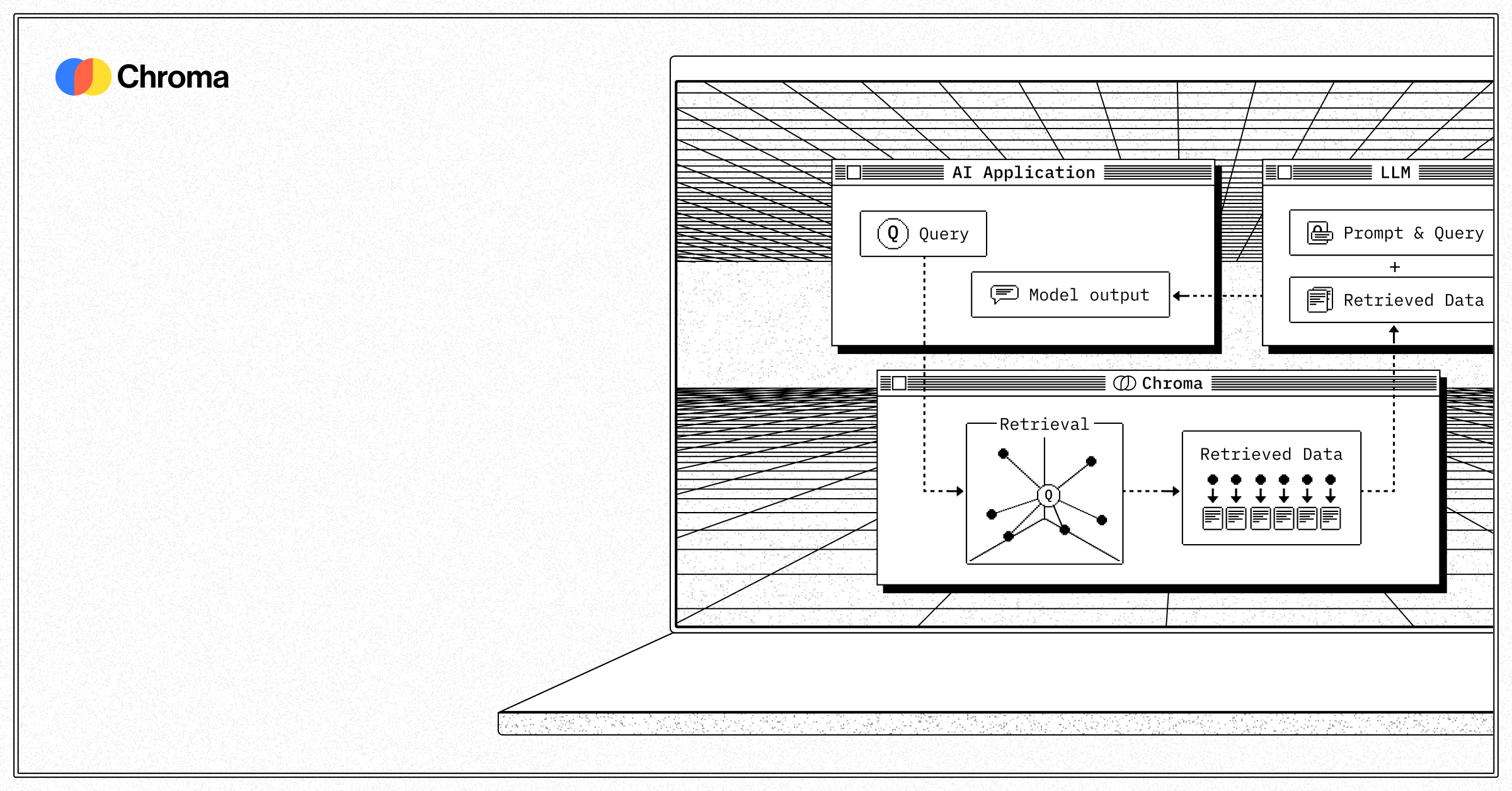
Chroma - Open-Source Vector Database for RAG Prototypes
Open-source search infrastructure for AI
- pytorch.org
PyTorch - Deep Learning Framework (Official)
 secondtalent.com
Top 8 AI Frameworks and Tools to Master in 2026
TL;DR: PyTorch leads research with 55% of papers. LangChain powers 51% of production AI agents. Master these 8 tools to build modern AI systems. What’s...
 huggingface.co
Hugging Face - Model Hub and Transformers Library
We’re on a journey to advance and democratize artificial intelligence through open source and open science.
 developers.llamaindex.ai
LlamaIndex Developer Docs - Data Framework for LLM Agents
- docs.langchain.com
LangChain Providers and Integrations Catalog
Integrate with providers using LangChain Python.
